


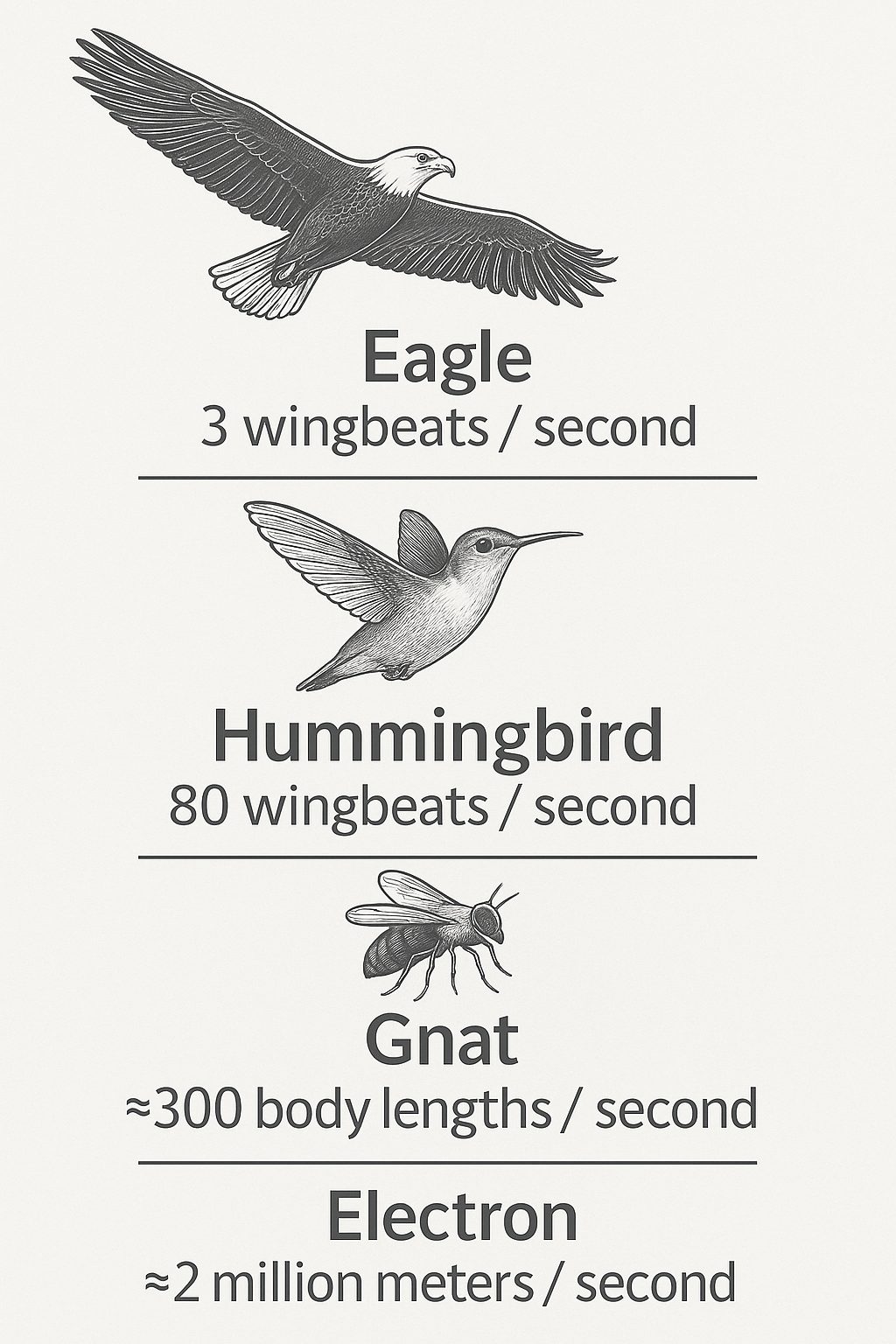
The speed of different creatures, Chapter 2 in Electrons: How They Navigate Around an Atom
Please leave general questions, comments, corrections, or clarifications below so other readers can benefit from the discussion.
For private questions or download problems, you’re welcome to reach me through the contact page.
This page will evolve as readers raise new questions or as later volumes clarify earlier ideas.
Clarifications & small notes
- Clarifications here address points that readers have asked about after reading.
- None of these are required to follow the main text.
(This section will grow slowly and intentionally.)
Common reader questions
What Volume I does—and does not—try to do
Volume I focuses on how electrons move around protons—not like static marbles or miniature planets, but as high-speed travelers that face constraints as they dart around the nucleus of an atom.
This volume introduces the geometric framework.
Subsequent volumes apply it to electron shells, bonding, and eventually water and biological molecules.
Questions or comments
If you have a question, clarification, or correction, you’re very welcome to reach me through the contact page.
Reader questions help shape future clarifications and later volumes.