
Making chemistry visible, one molecule at a time
Ebook Series: How Atoms Form Molecules
A visual ebook series
What this series is: This visual series explains how electrons move, why orbitals have shape, and how simple geometric rules build atoms and molecules.
If you’ve ever wanted chemistry to finally make sense, this series was written for you.
Volume I
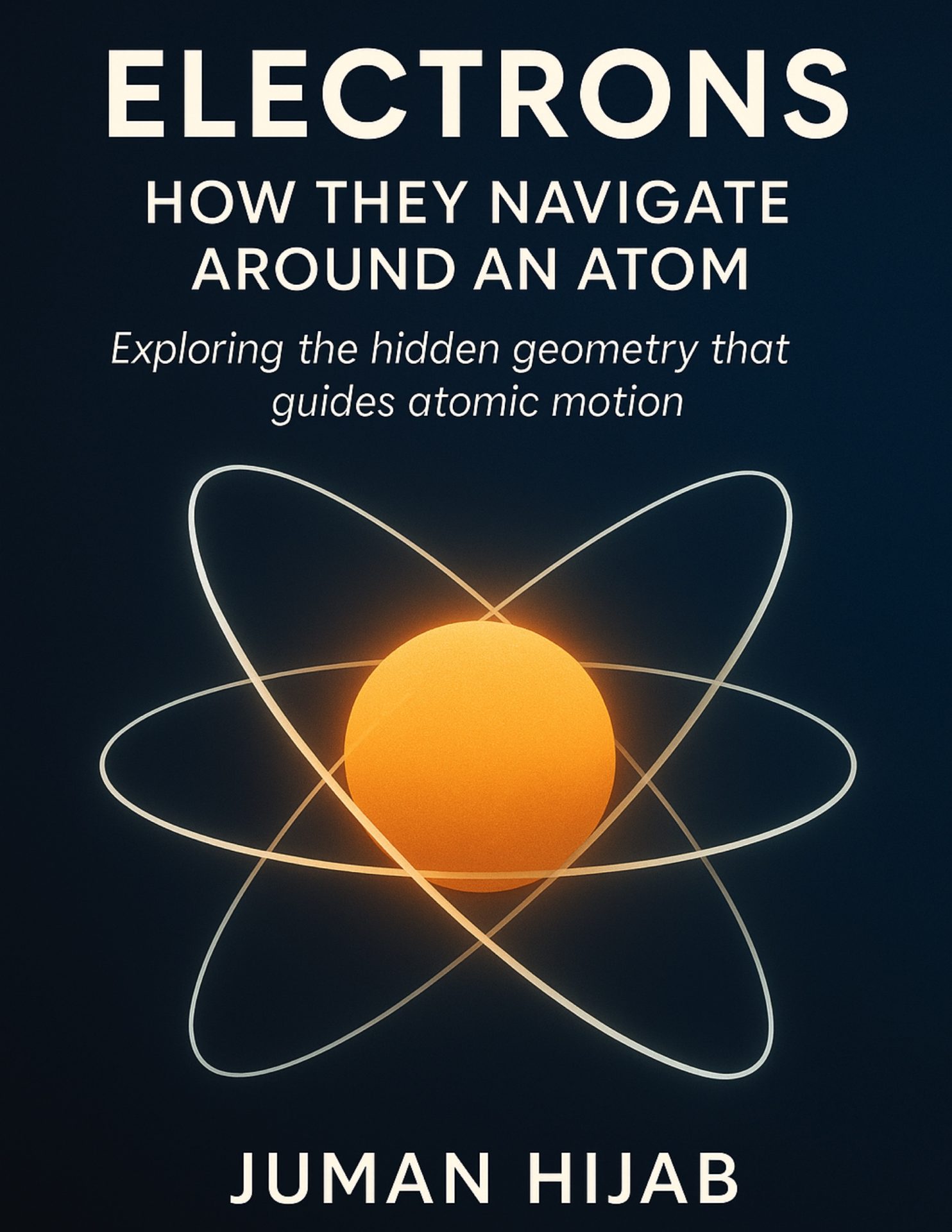
I. Electrons: How They Navigate Around an Atom
Exploring the hidden geometry that guides atomic motion
See sneak peek below
Available now
Volume II
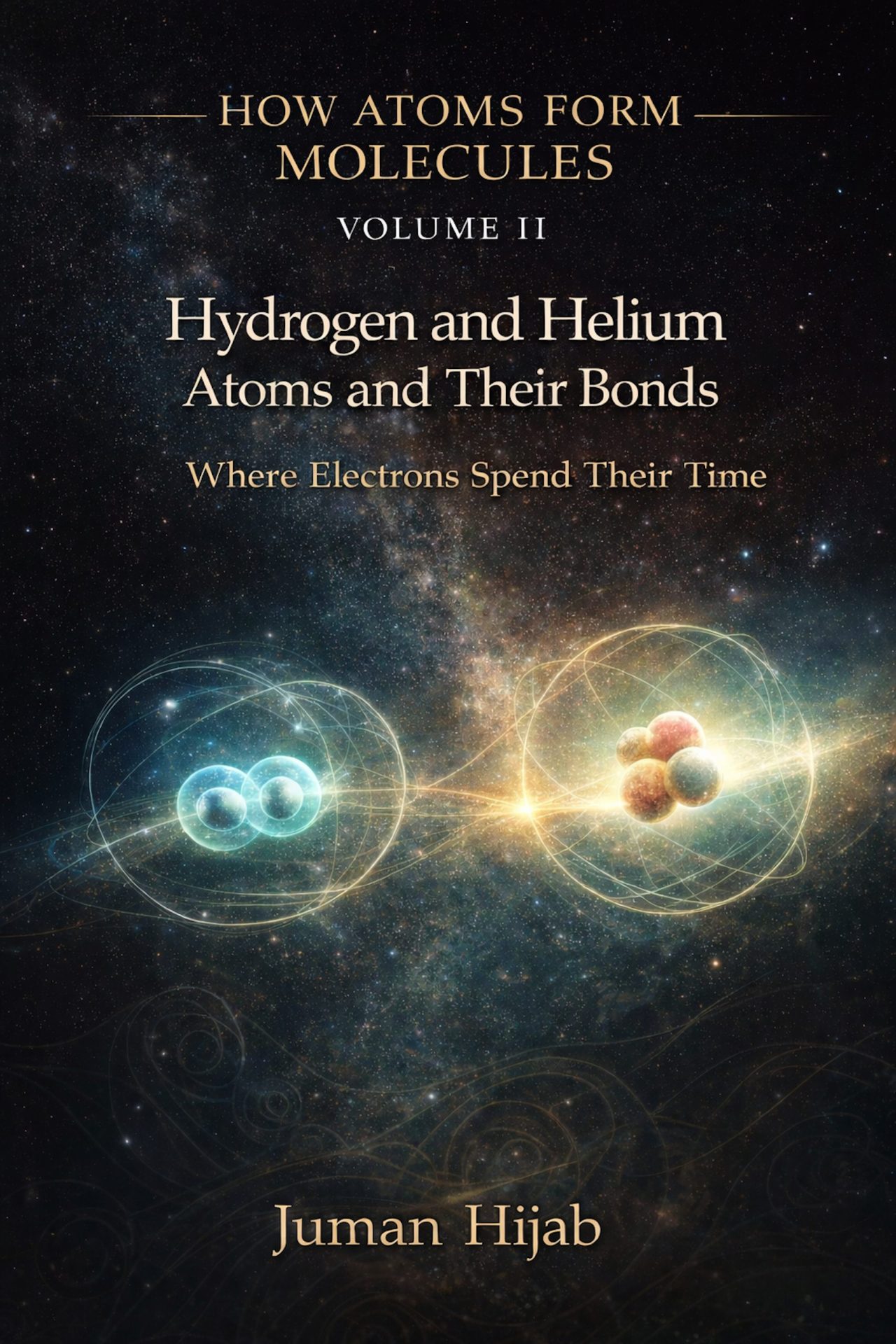
II. Hydrogen and Helium Atoms and their bonds
Where electrons spend their time
Available now
Volume III
III. The Geometry of Orbitals
III. The Geometry Of Orbitals
How electrons sculpt the shapes of the s, p, d, and f orbitals
Available now
This finally made electrons make sense to me. — Reader

Meet the Author
I explore the space between chemistry and life, asking questions such as:
– Why biology relies on so few molecular building blocks
– How protons and ions move through living systems
– Why water shapes nearly every biological process
Sneak Peek Inside
Volume I
Introduction
Most of us rarely think about electrons—yet every breath, spark, and heartbeat depends on them.
They are the tiny movers that give matter its structure, chemistry, and even its ability to exist.
An oxygen atom, for instance, holds eight electrons. Four of them join forces with another oxygen’s four to form the O₂ molecules we breathe. But to understand how those electrons decide to pair up, we must look more closely at what electrons are and why they move the way they do.
In this mini-book, I’ll focus on two guiding questions:
1. What are electrons, and where did they come from?
2. What defines an electron’s behavior within an atom?
By the end of this short journey, you’ll be able to visualize three key aspects of electron motion:
•The speed at which electrons travel.
•Why they are drawn toward the nucleus.
•The invisible constraints that shape their motion.
This is the first volume in a series exploring how atoms form molecules.
✦ ✦ ✦
Key idea:
If we can picture electrons as restless travelers moving along invisible highways around a city—the city being the nucleus—we can understand how those same electrons link atoms together into molecules like oxygen, water, and every living cell’s foundation.
✦ ✦ ✦
1. What Are Electrons and Where Did They Come From?
When the universe was born, it was pure energy—an immense, searing ocean of light.
As it expanded and cooled, that energy condensed into matter. The simplest particles to appear were protons, neutrons, and electrons.
You can think of electrons as the tiniest, most agile drops of that original energy. They were born from the cooling of light itself—energy taking form. Electrons carry a negative charge, forever drawn to positive charges like protons, yet their restlessness keeps them from ever falling into the nuclear mesh of protons and neutrons.
An electron isn’t a marble or a speck of dust. It’s more like a swirling pattern of presence, a vibration of space itself. If you could somehow see one without disturbing it, you wouldn’t see a dot—you’d see a mist of probability, thicker in some regions, thinner in others. That mist shows where the electron is most likely to be found.
Each electron is both a traveler and a trace:
The traveler carries mass, charge, and energy.
The trace is its faint electric field, left behind as it moves.
Electrons were forged in the first seconds of the universe and have been moving ever since.
In ordinary matter, none have been created or destroyed—they simply change homes, jumping from one atom or molecule to another as the universe builds, burns, and rebuilds.
Only under extreme conditions, such as inside certain radioactive atoms or particle collisions, can an electron vanish—its energy merging with a proton to form a neutron, or meeting its antimatter twin to become pure light.
Even then, its essence isn’t lost, only transformed—its energy and charge folded back into the universe’s ongoing cycle.
Thus, every time you touch metal, breathe air, or feel warmth, you’re meeting ancient travelers—electrons that have journeyed through stars, planets, and living things for over thirteen billion years. The next section describes how these ancient travelers behave once they find themselves inside an atom.
Why I Wrote This Series
I’ve always loved patterns — the ones that reveal how matter behaves.
Too much chemistry is taught as disconnected facts, not as a story with a clear internal logic.
I wanted to reveal the simple geometric rules that make atoms behave the way they do.
Hi, I'm Juman.
It's great to see you!
I've had a lifelong interest in what makes cells tick. I want to understand cells, health and disease at the molecular level in a way that makes sense.
I’ve spent years studying how atoms, molecules, and symmetry shape the physical world — and I wanted to explain it the way I wish it had been explained to me
The How Atoms Form Molecules series is the first series in a larger project that explains atoms, small and large molecules, and water — the molecule that makes life possible.
“I understand orbitals and their shapes so much better now that I can see the geometry that supports them."