



Flat bottom clouds. Image by JohnKay, Flickr.com
What weather clouds can teach us about orbital boundaries
We know electron clouds are probability distributions.
But that got me thinking:
- Clouds — like flat-bottom clouds — can have visible boundaries.
- Electron clouds also seem to have boundaries.
A weather cloud is not an electron cloud. But a weather cloud can help us picture how something can have an edge without having a physical wall.
Flat-bottom clouds: boundaries without walls
Some clouds look as if they are whipped cream sitting on an invisible glass plate. Their lower edges can be surprisingly flat.
Of course, there is no plate.
The boundary forms because the air conditions change. Above that level, water droplets can remain suspended and visible. Below that level, the conditions no longer support the same visible cloud.
Weather clouds are made of tiny water droplets or ice crystals suspended in air, and we see their edges because light scatters across countless water-air and ice-air boundaries (see how do clouds form in 5 easy steps).
Electron clouds are not weather clouds. They are probability patterns.
But the cloud analogy gives us one useful idea:
Nature can make an edge without building a wall.
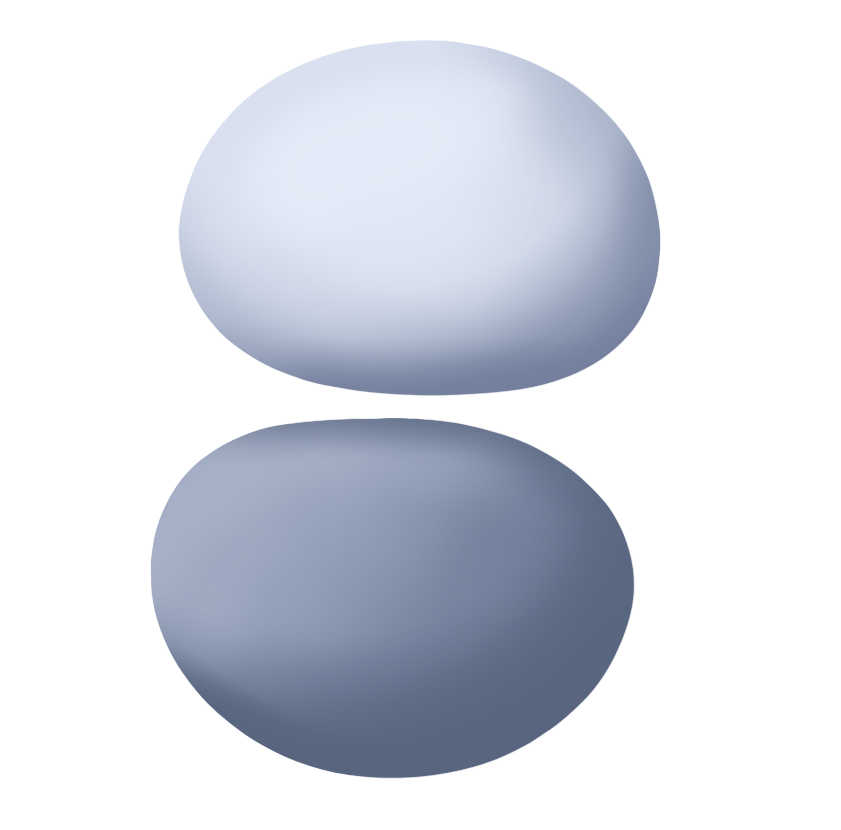
p orbitals. Image by Irina Drazhina (from III. The Geometry of Orbitals, Lifeschemistrypress.com
Electron clouds - and where the cloud analogy stops
A p-orbital lobe may look like a rounded drop with a somewhat flattened base. But flat-bottom clouds and p-orbitals are different.
A flat-bottom cloud forms where atmospheric conditions stop supporting the same visible cloud pattern.
A p-orbital lobe has a different kind of boundary.
It marks the place where the electron probability pattern becomes too faint to show, cancels at a node, or can no longer sustain that shape.
So the boundary is not a wall.
It is a limit in the pattern.
An intuitive p-lobe explanation
A p-orbital lobe looks a bit like the rounded top of an ice cream cone, or a soft teardrop. It is widest away from the nucleus, then narrows inward toward the center.
The intuitive reason is simple:
- The electron pattern cannot spread equally in every direction. It has been given a direction.
A p-orbital has an axis. That axis gives the electron pattern a preferred direction.
A flat-bottomed p-lobe
Once direction appears, the pattern can no longer spread equally in all directions like a sphere. It must occupy a directional chamber.
Farther from the nucleus, that chamber is wide. Closer to the nucleus, the chamber narrows.
The lobe therefore behaves like a stack of circular slices: broad near its middle, smaller as it retreats inward, and too narrow to continue smoothly at the center.
This gives us the “flat-bottomed circular” feeling:
- Large slices farther out.
- Smaller slices closer in.
The bottom of the p-lobe is the place where the lobe has narrowed so far that the probability pattern can no longer keep that same rounded form.
The p-lobe does not sit on a plate.
It runs out of room.
Key takeaway
The p-lobe does not have a hard edge.
It has a geometric limit.
Like a cloud, it can appear to have a boundary without having a wall.
I’m preparing a serialized early release of Volume III: The Geometry of Orbitals.
If this way of seeing orbitals speaks to you, I’d love to invite a small group of beta-readers to receive early installments and share feedback.
Header image credit: White clouds over mountain, by Brett Sayles, from Pexels.com