


Seeing Electrons: How Tiny Travelers Shape Every Atom
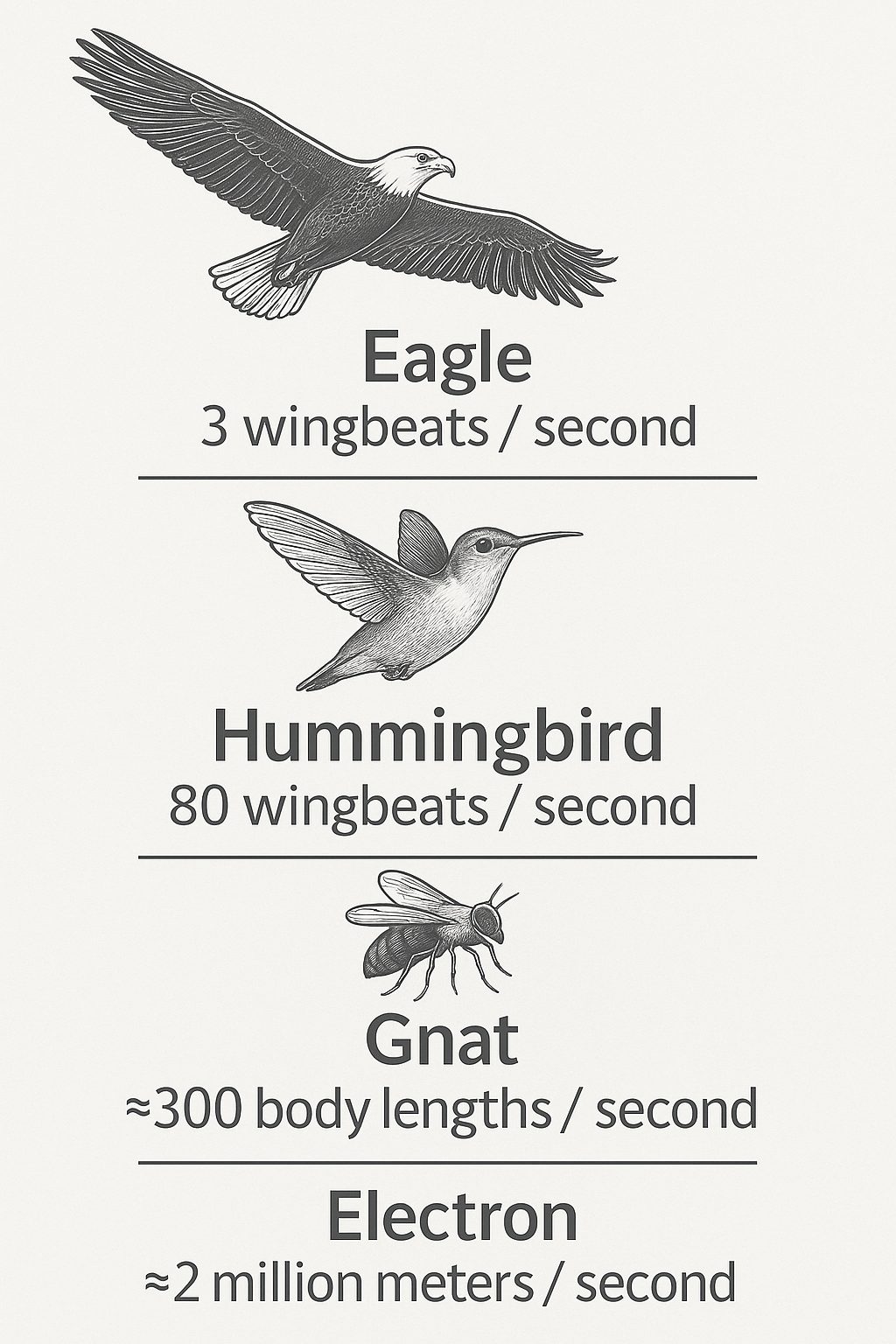
If you’ve ever watched a hummingbird hover over a flower, you know how mesmerizing fast motion can be. Wings that blur. A body that seems to float. Movement so quick your eyes can barely track it.
Now imagine something much smaller — a gnat darting through a ray of sunlight, or dust dancing near a window.
Fast. Restless. Unpredictable.
These two creatures — the hummingbird and the gnat — are the closest everyday glimpses we have of something even more astonishing: electrons that are roughly a billion times smaller than a gnat—and they “move” millions of times faster.
The problem: electrons are invisible, but essential
Electrons move so fast, so constantly, and so unpredictably that we can only describe them as a mist of possibility. Yet they’re responsible for everything around us — the breath you take, the color of the sky, the molecules that make life possible.
And the deeper truth?
Their motion isn’t random.
It’s guided by geometry — tiny highways and pathways that shape where they can go.
A better picture: a tiny traveler following hidden highways
Electrons behave less like planets and more like travelers moving through a landscape with invisible rules:
- They move constantly.
- They are pulled inward by protons.
- They must keep a safe distance to avoid collapsing inward.
- They must avoid colliding with each other.
- They settle into patterns that minimize strain.
This creates something beautiful:
stable, symmetric shells shaped by geometry.
And once you see electrons this way, chemistry becomes surprisingly simple.
What finally made electrons “click” for me
For years, I struggled with electrons because the explanations were either too mathematical
- too vague
- or too focused on memorizing diagrams
But once I began using geometry and motion — patterns, distances, constraints — the fog lifted.
Electrons weren’t mysterious anymore.
They were predictable, beautiful, and even intuitive.
So I wrote a short book about it
A friendly introduction.
No equations.
Just clear stories, crisp analogies, and simple diagrams.
It’s called:
Electrons — How They Navigate Around an Atom
And it’s the first volume in a series about how atoms form molecules.
If you’d like to see electrons the way I now see them —
as tiny travelers following geometric rules —
you can learn more here:
👉 Explore the Book
I’d love to hear from you
If you read the book and have thoughts, questions, or corrections, please share them in the comments below.
This series is meant to grow — and your insights help shape it.